Request Quotes Directly From The Airlines Listed Below or Use Our Free Quote Request Service and Receive Up To 3 Competitive Quotes

Charter Flight Network Is Proudly Canadian Owned & Operated Since 2008
Charter Flights To Alert Nunavut
This page features charter flights to Alert along with links to the airlines best positioned and equipped to provide the service you require. Link to any airline listed and request a price quote and availability.
Save time and use our no-obligation charter quote request form to receive up to three competitive quotes tailored to your specific needs. Receive quotes directly from the airlines..
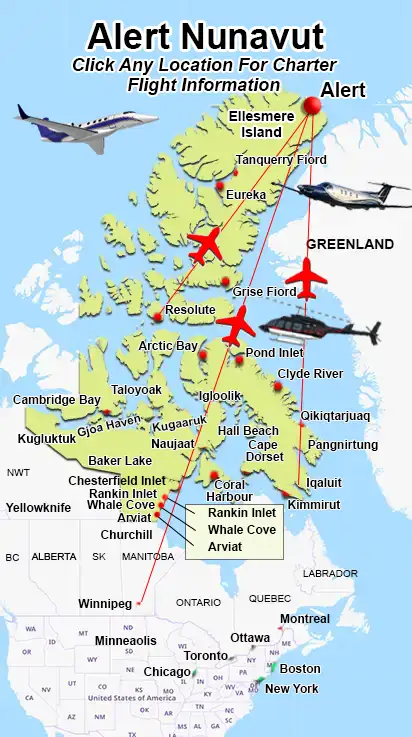
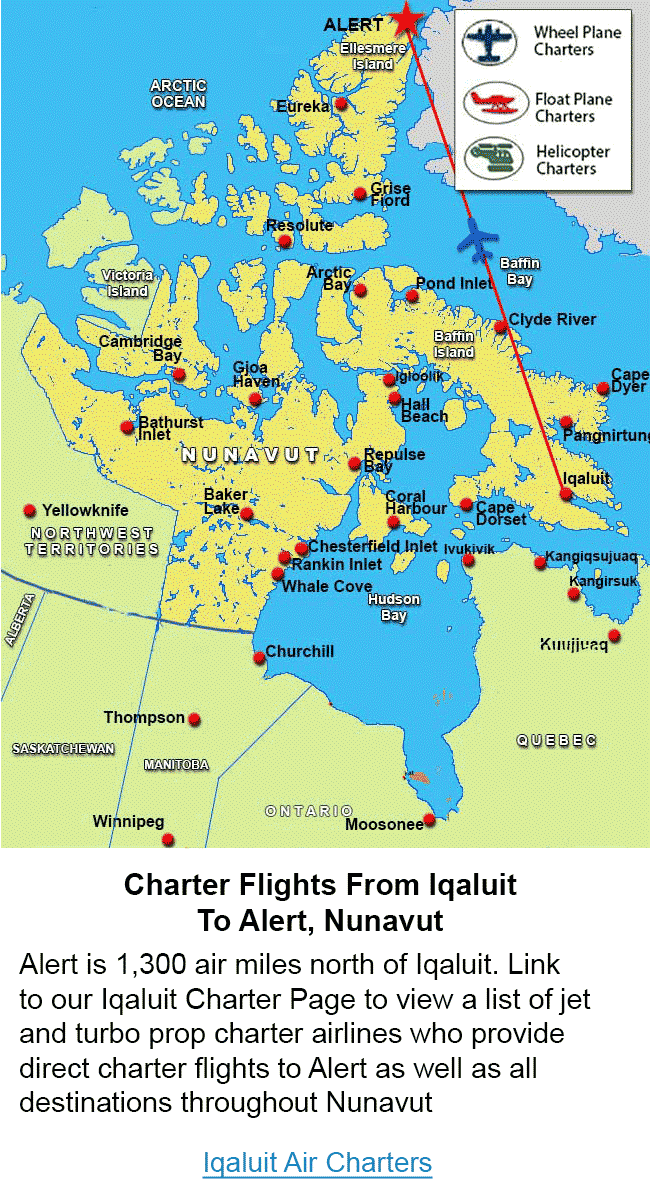
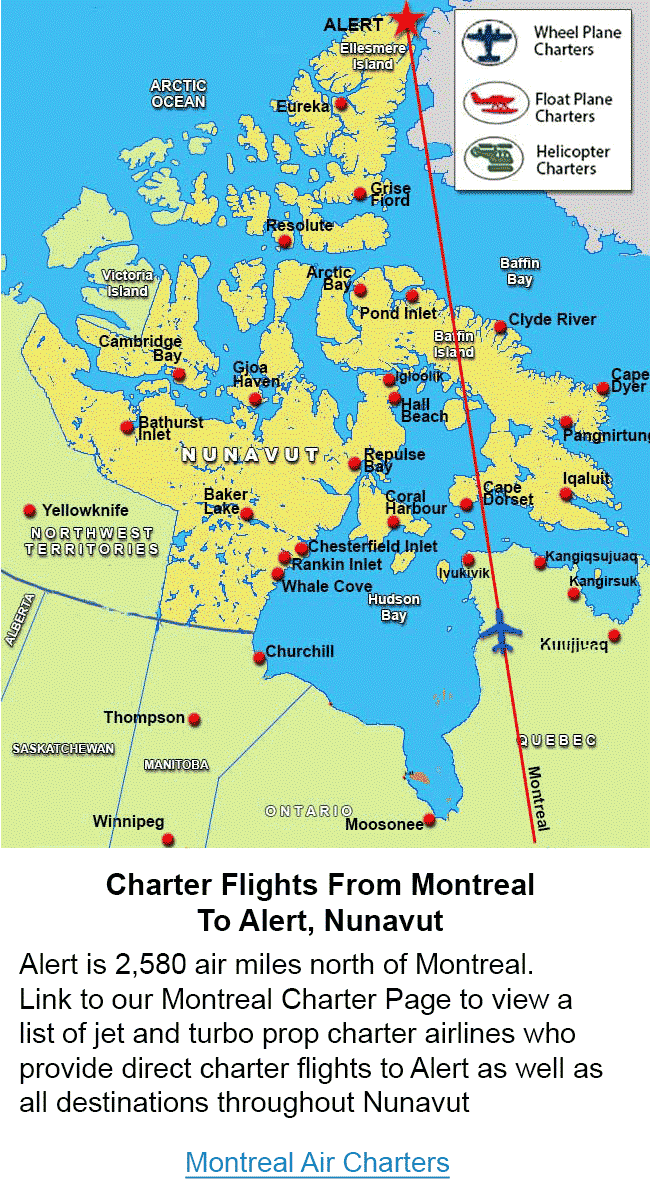
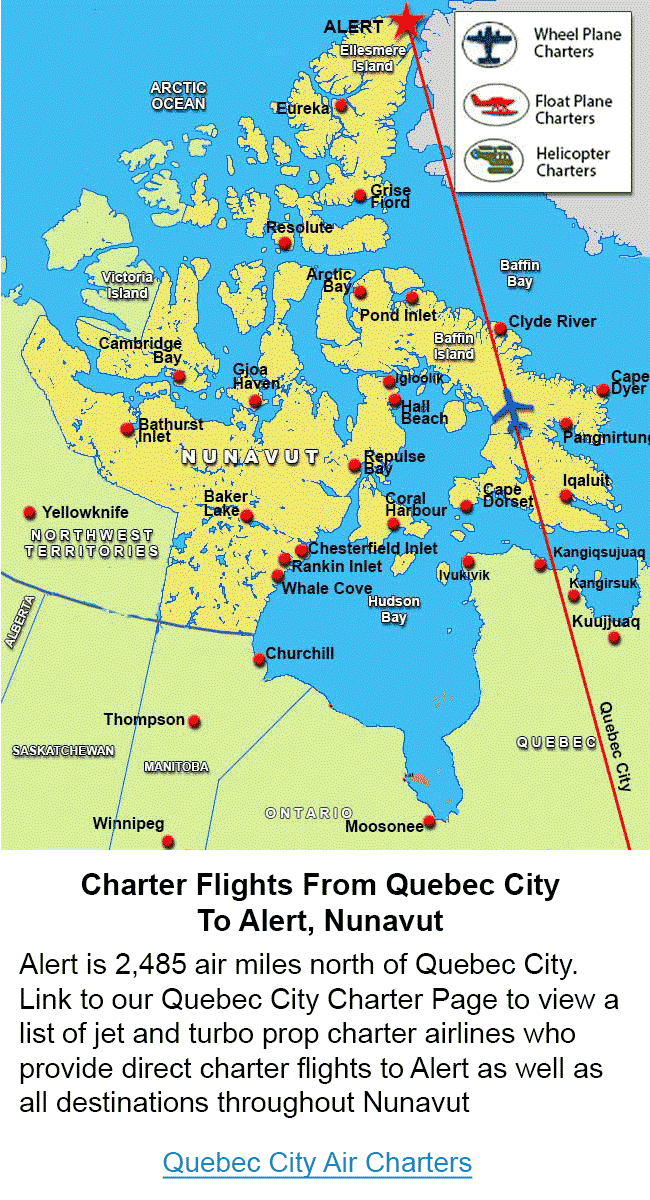
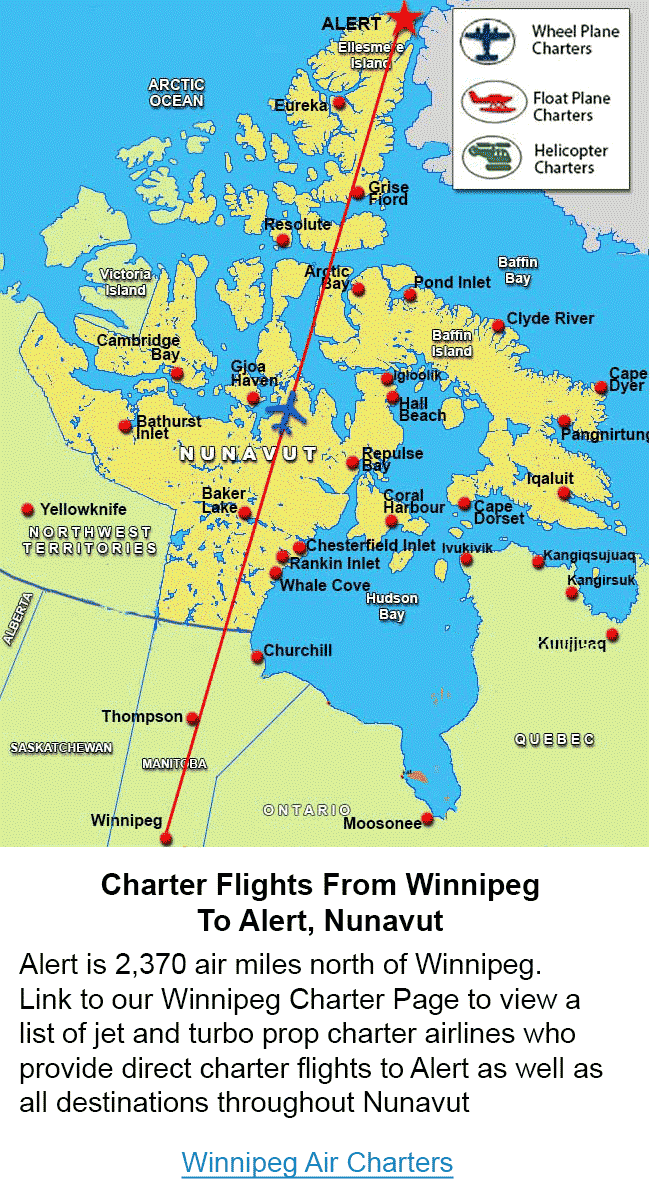
Alert, Nunavut, is a truly unique location situated at the northeastern tip of Ellesmere Island in the Qikiqtaaluk Region of Canada. Located only 817 kilometers (508 miles) from the North Pole, Alert is the northernmost permanently inhabited place in the world. It lies approximately 2,092 kilometers (1,299 miles) north of Iqaluit, Nunavut's capital, and about 4,092 kilometers (2,542 miles) northeast of Winnipeg, Manitoba. Accessible primarily by air, this remote Arctic outpost is surrounded by some of the planet’s most pristine and extreme environments.
The Alert Airport, located at the northernmost tip of Ellesmere Island in Nunavut, serves as a vital transportation hub for one of the most remote places on Earth. Operated by Canada’s Department of National Defence (DND), this restricted-access airport supports military operations, scientific research, and essential supply missions in Alert. Due to its strategic and sensitive location, prior permission is required before landing at the airport, ensuring controlled and secure operations.
The airport features a gravel runway measuring 5,500 feet (1,676 meters) in length, capable of accommodating specialized aircraft designed for Arctic conditions. The types of aircraft operating at Alert Airport primarily include cargo planes such as the C-130 Hercules and CC-177 Globemaster, which deliver supplies and equipment to support the Canadian Forces Station (CFS) Alert and weather research facilities. Occasionally, smaller aircraft configured for Arctic missions are used for personnel transport and emergency medical evacuations
Alert plays a vital role in global scientific and environmental efforts. Home to the Canadian Forces Station Alert, the settlement serves as a critical hub for weather research, climate monitoring, and Arctic communications. Scientists and researchers stationed here collect valuable data on atmospheric conditions, aiding in the prediction of global weather patterns and studying the effects of climate change in the Arctic. The strategic location of Alert makes it an essential part of monitoring the Earth's climate, as changes in the polar regions significantly impact global ecosystems.
Operated by the Canadian Forces Station (CFS) Alert, the area supports military and strategic operations in the Arctic. Key missions include communications interception, strategic surveillance, and maintaining Canada's sovereignty in the High Arctic. The station is staffed year-round by military personnel, scientists, and support staff.
Positioned just 817 kilometers (508 miles) from the North Pole, Alert plays a crucial role in weather research, climate monitoring, and military operations in the Arctic. As the lifeline to this isolated outpost, the Alert Airport is critical for maintaining operations and ensuring the safety of those stationed in the region. Its role highlights the importance of aviation in connecting even the most remote parts of the world, providing access to vital resources and supporting Arctic exploration and research.
Alert is home to one of Canada's most important weather stations, collecting valuable atmospheric data for use in global weather forecasting and research. The station monitors key indicators such as temperature, wind patterns, and air pressure, providing essential insights into Arctic weather systems. Additionally, climate scientists at Alert focus on studying long-term climate trends and the effects of climate change on polar environments. By analyzing changes in sea ice, snow cover, and greenhouse gas levels, researchers contribute to understanding the global impact of a warming Arctic.

Alert typically hosts a small, rotating population of approximately 50 to 60 personnel, depending on the season. This includes Canadian military members, civilian contractors, and researchers. Due to its remote location and extreme conditions, there are no publicly available accommodations or tourism facilities in Alert. Visits are restricted and require government approval. Alert's unique combination of scientific, environmental, and military significance makes it a vital outpost in the Arctic. Its work not only contributes to Canada's Arctic presence but also supports global efforts in understanding and adapting to our changing climate.

Summer in Alert, lasting from late June to August, offers brief respite from the intense cold. Temperatures typically range between 0°C and 5°C (32°F to 41°F), with occasional peaks slightly above freezing. The Arctic summer is marked by 24-hour daylight, known as the Midnight Sun, which bathes the landscape in constant light. Despite the cool air, this period is essential for fieldwork, wildlife observations, and scientific studies, as the tundra briefly comes alive with mosses, lichens, and hardy Arctic flora.
Winter dominates most of the year in Alert, with temperatures plunging between -30°C and -50°C (-22°F to -58°F). Wind chill can make conditions feel even colder. The polar night, spanning months from October to February, envelops Alert in complete darkness, offering breathtaking views of the Northern Lights. This is a challenging time, but critical for ongoing weather and climate monitoring operations.

Discover How to Upgrade Your Basic Free Listing To A Highly Visible Featured Listing